
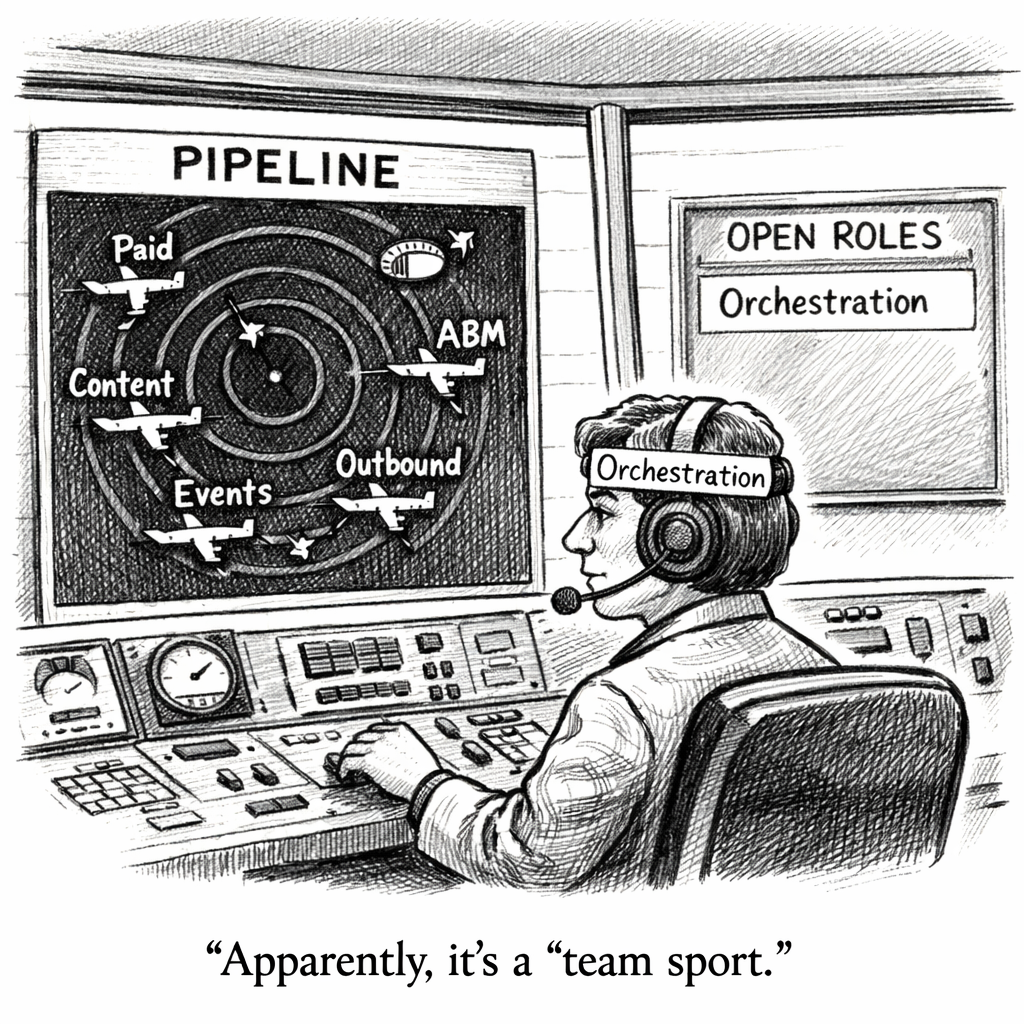
The best demand gen VPs don't act like campaign managers. They act like air traffic controllers. They're not running the plane. They're not flying the route. They're making sure every aircraft knows where every other aircraft is, when it's safe to move, and what the approach pattern looks like so nobody crashes into each other on the tarmac.
Korstiaan Hardman from SAP describes demand managers as custodians of the pipeline. Not owners. Not operators. Custodians. The distinction matters because a custodian maintains something on behalf of the organization. They don't own it; they steward it. They make sure it's clean, available, and functioning properly. And crucially, they're not responsible for every detail; they're responsible for making sure the details are attended to by someone.
This is the job your job description didn't describe. You probably have "manage demand generation strategy," "own pipeline metrics," "lead cross-functional campaigns." Those are the visible things. The actual job is smaller and bigger at the same time. It's smaller because you're not executing every campaign yourself. It's bigger because you're orchestrating every campaign across functions you don't directly manage. You need paid to do something. You need sales to do something. You need content to do something. And you're not their boss, so you can't mandate. You have to orchestrate.
The skills that separate good campaign managers from great demand gen leaders are almost entirely about orchestration. Can you see a gap before it becomes a breakdown? Can you run a meeting where everyone disagrees and leave with clarity? Can you translate business strategy into constraints for each function without making them feel like you're dictating their work? Can you read the room and know when someone is nodding but not bought in? Those are the skills that matter.
Earning the right to orchestrate across functions you don't directly manage is a process, not a title. It starts with delivering on what you say you'll deliver. It continues with making other people's jobs easier, not harder. When you ask paid to shift budget, you have research that shows why. When you ask sales to follow a new process, you've already worked through the implications with them. When you ask content to shift direction, you're giving them enough time and clarity to actually do it well. You're not an obstacle. You're a clarifier.
The conversation with your CRO that creates the mandate for true orchestration is actually just one sentence: "I'm responsible for pipeline, but I can't generate it alone. I need to be able to make decisions across functions." Once your CRO agrees that orchestration is your job, everything else becomes easier. You can call the meetings. You can ask the hard questions. You can make trade-offs that serve the pipeline, not individual teams. You've moved from campaign operator to system orchestrator.
Nobody posted this job. That's why nobody's doing it well.
Scott.