
This is the final secret in our series. It might be the most important one too.
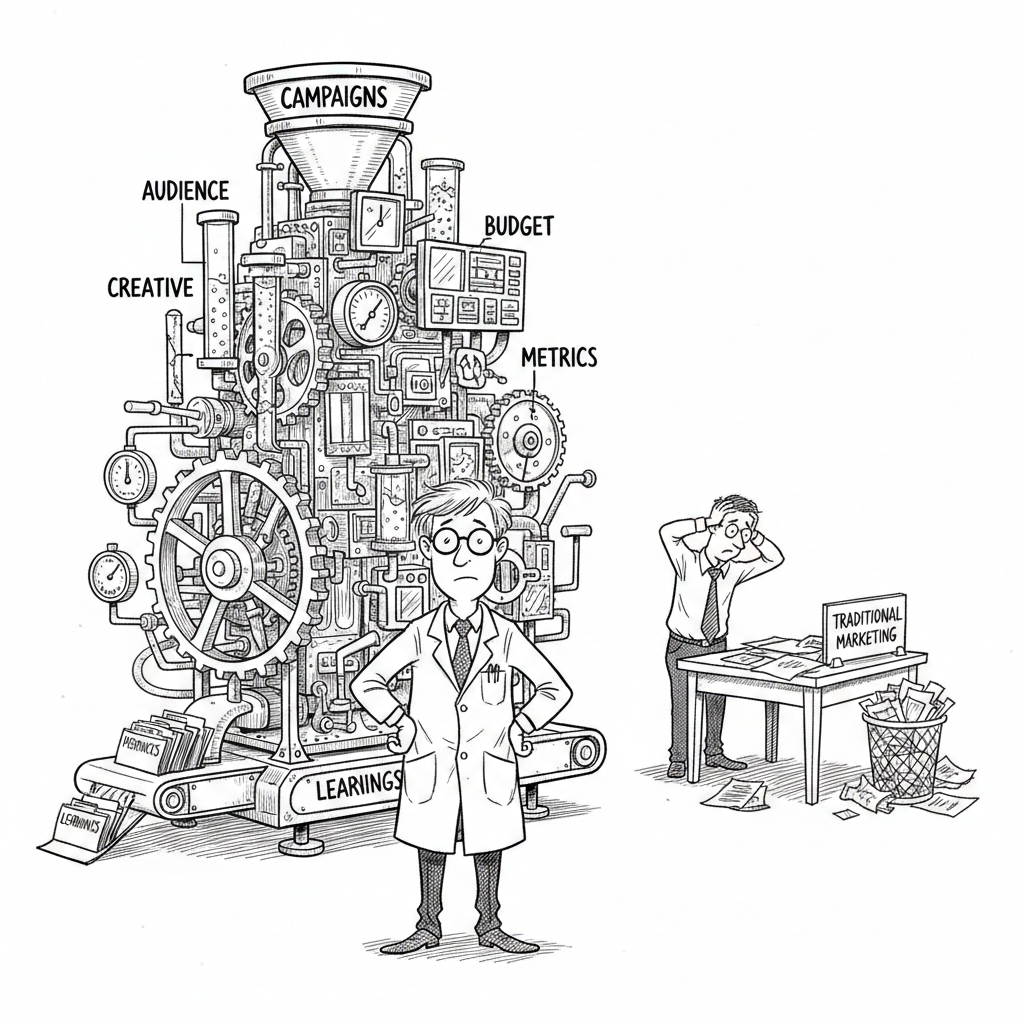
You can have the perfect ICP, the perfect winning creative, the perfect real-time feedback loops, and the perfect metrics. But if you're not capturing what you learn along the way, you're still starting from scratch every single quarter.
 That sounds like 101 stuff, but many teams operate with a one-and-done mindset. Meaning that they launch a campaign, hope it works, then move to the next quarter. They repeat the same mistakes because no one documented what failed. Every new campaign starts from zero because there's no institutional memory.
What we see is that the teams that consistently win, treat every campaign as a series of experiments where wins and losses both create valuable insights. Their learnings compound across teams, quarters, and even when agencies change or people leave.
B2B companies making decisions based on ROI data achieve 15-20% higher revenue growth (Martal Group). Companies with aligned sales-marketing criteria see 38% higher win rates. The difference isn't luck or bigger budgets—it's whether they're learning faster than their competitors.
Signs You Have a "No Learning" Culture
To paraphrase Jeff Foxworthy (picture me with a mullet and a moustache if you need to), if you're having the same debates every quarter like "Should we try LinkedIn again?" You might have a "no learning culture".
If no one documented what was tested or why it failed. You might have a no learning culture.
If your agencies or new hires start from zero knowledge because nothing was written down. Mmmm, you might have a no learning culture.
What is going to happen is that you will keep repeating mistakes because no one remembers what didn't work six months ago.
Signs You Have a "Learning Machine" Culture
You maintain a documented experiment log: hypothesis → test → result → learning. There's a shared repository of winning patterns for audiences, creative, and messaging that everyone can access. You run pre-mortems before launches: "What could go wrong, how will we know, and how fast will we know it?" You hold regular learning reviews, not just performance reviews where people defend their numbers.
The Simple Experiment Template
You don't need a PhD to do this. You just need structure.
Hypothesis: We believe that [specific change] will [expected outcome] because [reasoning]
Test variant(s): Description of what we're testing
Success metric: Primary KPI and threshold
Decision rule: If X happens, we do Y - and have a hard line in the sand. You don't want to keep something going if it isn't working.
Outcome: What actually happened
Learning: What we'd do differently next time
Example:
Hypothesis: We believe that pain-focused hooks ("Wasting budget on bad leads?") will outperform feature-focused hooks ("AI-powered platform") because our ICP cares more about outcomes than features.
Variants: 3 pain hooks vs 3 feature hooks
Success metric: CTR and CPL
Decision rule: If pain hooks improve CTR by >15% with comparable CPL, we shift all creative in that direction.
Outcome: Pain hooks had 28% higher CTR, 12% lower CPL
Learning: Lead with pain, follow with solution. Feature-speak doesn't resonate with our audience.
How to Store and Reuse Learnings
Keep a central doc or sheet accessible to marketing, agencies, and sales. Create categories for everything: Audiences, Creative, Channels, Timing, Messaging. Review it regularly during campaign planning: "What did we learn last time that we can apply here?"
At Yirla, we automatically document what's working across all your campaigns so you're not relying on someone's memory from three months ago. We create institutional knowledge that survives team changes, agency transitions, and exec departures. And we make best practices portable across accounts so you're not reinventing the wheel every quarter.
The gap between good and great B2B campaigns in 2026 isn't budget or headcount. It's whether you're running campaigns like projects or like learning machines.
Wrapping Up: The Five Secrets
Over the past week or so, we've covered:
- Evidence-based ICP and intent - Stop targeting everyone, start targeting the right ones
- Creative from patterns, not opinions - Let data drive creative decisions, not the HiPPO
- Real-time feedback loops - Catch problems at $500, not $5,000
- Measure what matters - Pipeline contribution beats vanity metrics
- Learning machines - Compound insights across campaigns and teams
The teams winning in 2026 aren't the ones with the biggest budgets. They're the ones executing these five secrets with discipline and speed.